

When someone searches for a service in Denver, they often want an answer quickly. They may search for a plumber near them, a local marketing agency, a dentist in their neighbourhood or a roofing company that can visit their property. That is where Google Maps becomes important. A strong Google Business Profile can put your business in front of people who are actively looking for what you offer. But appearing in local search is not simply about adding a few keywords to your profile. Google considers several signals when determining which local businesses are relevant to a search. In this guide, I will explain how Google Maps SEO in Denver works and the practical areas I would focus on when improving a local business presence.
What Is Google Maps SEO?
Google Maps SEO is the process of improving a business’s visibility in Google Maps and local search results. Google’s own guidance says local results are mainly influenced by three factors: relevance, distance and prominence. Relevance concerns how well a business matches the search, distance considers the searcher’s location, and prominence reflects how well known the business is.
This is different from traditional organic SEO. A website might rank well nationally for an informational search, while a local business needs to demonstrate that it is relevant to customers in a particular geographical area.
Google Maps vs traditional Google Search
Traditional SEO generally focuses on improving a website’s organic visibility. Google Maps SEO focuses heavily on the business’s local presence, including its Business Profile, reviews, location, website and other signals that help Google understand the business. For a Denver business, the goal is not simply to attract visitors from anywhere. The goal is to become more visible when relevant customers are searching locally.
What is the Google local 3-pack?
The local 3-pack is the group of local business results that can appear prominently within Google Search for location-based queries. For example, someone might search for “SEO agency Denver” or “roofing company near me”. Google can display local businesses alongside information such as reviews, opening hours, location and other profile details. There is no guaranteed method for securing a particular position. Google says businesses cannot request or pay for a better local ranking.
How Google Maps Rankings Work
Before changing your profile, it helps to understand what Google is trying to achieve. The search engine wants to connect users with businesses that are relevant to their query and location.
Relevance, distance and prominence
These three areas provide a useful framework for local SEO. Relevance means your business needs to clearly communicate what it does. Distance relates to how close the business is to the searcher’s location or the location specified in the query. Prominence relates to how established and well known the business is across relevant signals.
For a Denver business, these factors can vary considerably depending on where the customer is searching from. For example, a business in Downtown Denver may have a different local search landscape from one serving customers around Cherry Creek or Washington Park.
What should you improve first?
When reviewing a local business, I would normally start with the fundamentals rather than looking for shortcuts. The following four areas are a useful starting point:
- Business information: Check that your name, address, phone number, website and opening hours are accurate and consistent.
- Business category: Select the category that most accurately represents the main service your business provides.
- Customer reputation: Build a steady stream of genuine customer feedback and respond appropriately to reviews.
- Local authority: Develop relevant mentions, links and useful local content that strengthen the wider presence of your business.
Google specifically recommends keeping Business Profile information complete and accurate and responding to reviews.
Optimise Your Google Business Profile for Denver
Your Google Business Profile is one of the most important assets in a local SEO campaign. Google allows verified businesses to manage information such as their address, hours, website, phone number, services, photos and other profile details.
Start with the basics
Do not treat the profile as a place to insert as many keywords as possible. Instead, make the information genuinely useful to customers. Before moving on to advanced local SEO work, check these four areas:
- Business name: Use your actual business name rather than adding location or service keywords that are not part of your real-world name.
- Primary category: Choose the category that most accurately describes your core business.
- Contact details: Make sure your address, phone number, website and opening hours are accurate.
- Services and description: Explain what you actually provide in clear, customer-friendly language.
Accurate information also helps customers understand what your business does and when they can visit or contact you.
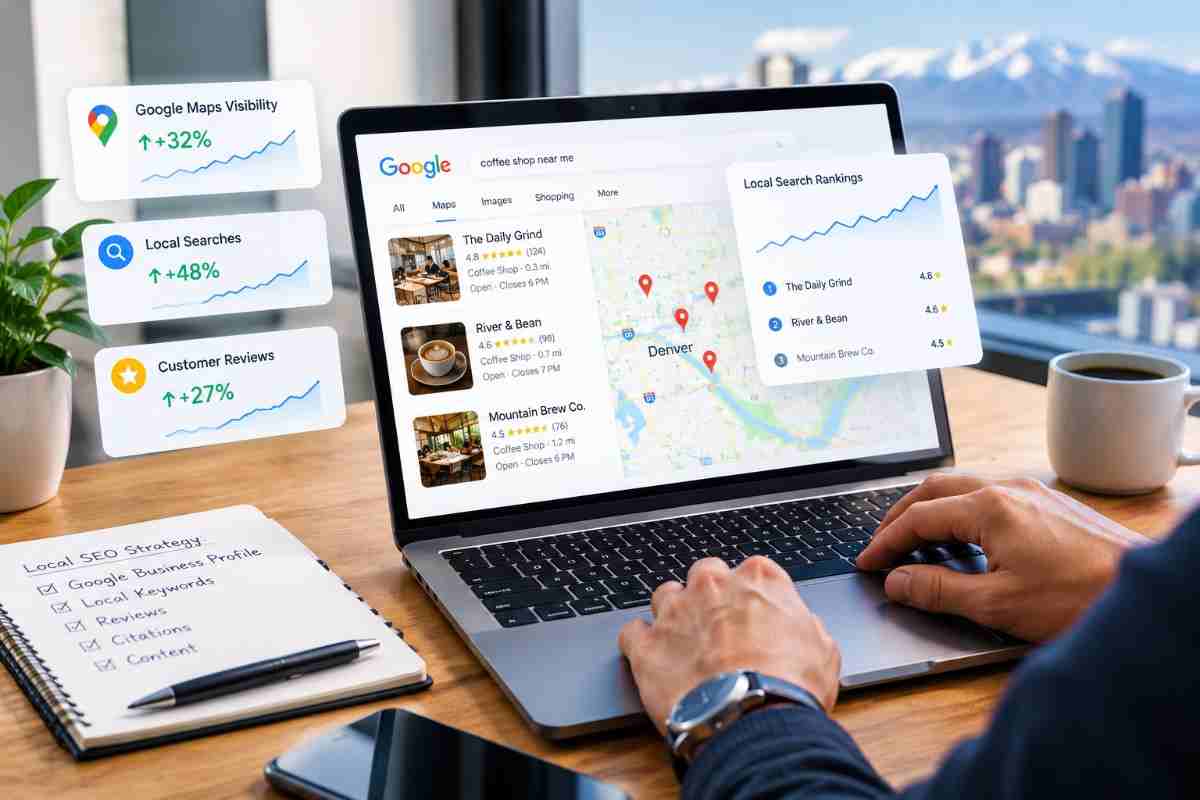
Use photos and videos properly
Photos are more than decoration. A customer deciding between several local businesses may want to see the premises, team, equipment, products or completed work before contacting a company. Use genuine images that represent the business rather than relying entirely on generic stock photography. Google also allows businesses to add photos and videos to their profiles.
Denver Local Keyword Research
Keyword research gives you a clearer understanding of how potential customers describe the services they need.
A Denver business might investigate searches such as:
- plumber Denver CO
- Denver SEO agency
- dentist near me Denver
- roofing company Denver
You can then look beyond the main city term and understand how customers search around specific areas.
Consider Denver neighbourhoods
Denver is not one uniform search market. Depending on the business, location-based searches may involve areas such as Downtown Denver, Capitol Hill, Cherry Creek, RiNo, LoDo, Five Points and Washington Park. The important point is not to create a separate page for every neighbourhood simply because it contains a keyword.
Create location content when you can provide something genuinely useful to people in that area. For example, a service business could create a useful local guide explaining its service area, common customer needs and relevant local considerations.
How to Get More Google Reviews
Reviews influence how customers perceive a business and are also part of Google’s local search ecosystem. Google recommends asking customers for reviews and says businesses can use a Google review link or QR code to make the process easier. It also prohibits incentives in exchange for reviews.
Build a genuine review process
The easiest approach is to make review requests part of your normal customer journey. Four practical steps can help:
- Ask at the right moment: Request feedback after the customer has received the product or service.
- Make it simple: Give customers a direct review link rather than making them search for your profile.
- Respond professionally: Thank customers and address legitimate concerns where appropriate.
- Never manufacture reviews: Do not buy reviews, create fake accounts or offer rewards for positive feedback.
A review strategy should be about customer experience first and SEO second.
Build Denver Local Citations
Citations are online references to your business, often containing information such as the business name, address and phone number. The goal is consistency and accuracy. Depending on your industry, you may consider relevant platforms such as Yelp, Bing Places, Apple Business Connect, industry directories and legitimate local directories.
Focus on quality rather than quantity
A long list of low-quality directories is not a substitute for a strong local presence. When building citations, check these four things:
- Accuracy: Make sure your business details are correct.
- Consistency: Avoid unnecessary variations in your business information.
- Relevance: Prioritise directories that relate to your industry or location.
- Trust: Avoid suspicious websites created purely to sell directory links.
Local SEO works better as an ecosystem than as a numbers game.
Create Location-Specific Website Content
Your website and Google Business Profile should support one another. If you serve Denver, your website should clearly explain your services and service areas. Useful content could include a Denver service page, relevant neighbourhood information, local FAQs and detailed service pages.
Avoid doorway-style location pages
Creating dozens of pages that simply replace “Denver” with another neighbourhood name can result in thin, repetitive content. Instead, make each location page useful. Explain what you offer, who you serve, the areas you cover and why the information is relevant to customers in that location. The purpose should be to help the visitor, not simply to create another URL for a keyword.
Local Backlinks for Denver Businesses
Links from relevant websites can contribute to the wider prominence of a business. For a Denver company, potential opportunities may include local organisations, industry associations, community publications, events and legitimate business organisations.
Earn links through genuine local involvement
Rather than buying large numbers of questionable links, look for reasons a local website would naturally want to mention your business. Four approaches worth considering are:
- Community involvement: Participate in relevant Denver events or community initiatives.
- Industry relationships: Build relationships with suppliers, associations and professional organisations.
- Useful resources: Publish original research, guides or data that local publishers can reference.
- Local expertise: Contribute genuinely useful insights to relevant publications and industry websites.
The strongest local links usually make sense even without SEO.
Photos and Google Maps SEO
Visual information can help potential customers understand your business before they make contact. For a local service company, this could include completed projects, staff photographs, equipment, vehicles, premises or examples of products.
What should you photograph?
Think about what a customer would want to see before choosing you.
Useful categories include:
- Exterior photographs: Help customers recognise the location when visiting.
- Interior photographs: Show the environment and facilities.
- Team photographs: Put real people behind the business.
- Work examples: Demonstrate the services or products you actually provide.
Keep images authentic and representative of the business.
Common Google Maps SEO Mistakes
Local SEO can become unnecessarily complicated when businesses chase shortcuts. Some of the most common problems are avoidable.
Watch out for these four issues:
- Keyword-stuffed business names: Your profile name should represent the real business name, not a collection of search terms.
- Fake reviews: Reviews should represent genuine customer experiences. Google explicitly prohibits incentivised and misleading review practices.
- Fake locations: Do not create locations where your business does not genuinely operate.
- Duplicate or inconsistent information: Conflicting business details can make your online presence harder to manage and understand.
The best local strategy is usually the one you can maintain consistently.
How Long Does Google Maps SEO Take?
There is no universal timeframe for local SEO. A new business, an established company entering a competitive market and a business with an already strong local presence will all start from different positions. Google also notes that new Business Profiles can take time to appear in search results, while changes to business information may take time to appear. Instead of promising a specific ranking within a fixed number of days, track meaningful changes over time. Look at visibility, profile interactions, search queries, calls, website visits and enquiries.
How to Track Google Maps SEO Results
A local campaign needs measurement. Google Business Profile performance data can show how customers discover and interact with a verified profile, including searches, views and other actions.
Track the metrics that matter
I recommend looking at four groups of data:
- Visibility: Monitor local rankings and how often your business appears for relevant searches.
- Profile activity: Review searches, views and customer interactions within Business Profile performance data.
- Reputation: Track review volume, ratings and the quality of customer feedback.
- Business results: Measure calls, website enquiries, bookings and leads rather than focusing only on rankings.
A ranking is useful, but a customer who contacts your business is much more valuable.
Why Choose Us for Google Maps SEO in Denver?
At Ahmed Raza, our approach is built around practical local SEO rather than chasing shortcuts. Every business has a different service area, customer base and level of competition. That is why we start by understanding the business before deciding which local SEO activities deserve attention. Our process focuses on the foundations: accurate Business Profile information, relevant local content, customer reviews, website optimisation, local authority and ongoing measurement. We also believe in explaining what is being changed and why. Local SEO should not feel like a black box where a business owner receives a ranking report without understanding what happened. The aim is to build a local presence that is useful to customers and sustainable for the business.
Final Thoughts on Google Maps SEO in Denver
Google Maps SEO in Denver is not about finding one secret trick that forces a business to the top of Maps. It is about making your business easier for Google to understand and easier for local customers to trust. Start with an accurate and complete Google Business Profile. Build a genuine review process. Make your website useful for Denver customers. Develop relevant local authority and measure the actions that actually contribute to business growth. Most importantly, keep the strategy focused on real customers. When your local SEO reflects the quality, location and services of your actual business, you have a much stronger foundation for long-term visibility.

Frequently Asked Questions
1. What is Google Maps SEO in Denver?
Google Maps SEO in Denver is the process of improving a local business’s visibility in Google Maps and local search results for relevant Denver-area searches. It involves your Business Profile, website, reviews, location and wider local signals.
2. How does Google rank businesses on Maps?
Google says local rankings are primarily based on relevance, distance and prominence. These factors help Google determine which businesses are appropriate for a particular local search.
3. Do Google reviews help local SEO?
Reviews are part of the information Google considers in local prominence, and they also help potential customers evaluate a business. Google recommends encouraging genuine reviews and responding to customer feedback.
4. Should I add Denver to my Google Business Profile name?
Only if “Denver” is genuinely part of your real-world business name. Adding keywords to a business name simply to influence rankings is not a sound local SEO practice.
5. Do I need separate pages for every Denver neighbourhood?
No. Create neighbourhood pages when they provide genuine value to customers. Avoid publishing large numbers of near-identical pages that only change the neighbourhood name.
6. How can I measure my Google Maps SEO performance?
Use Google Business Profile performance data alongside website analytics and lead tracking. Useful metrics include searches, profile views, interactions, calls, website visits, enquiries and conversions. Google provides performance data for verified Business Profiles.