
Overview
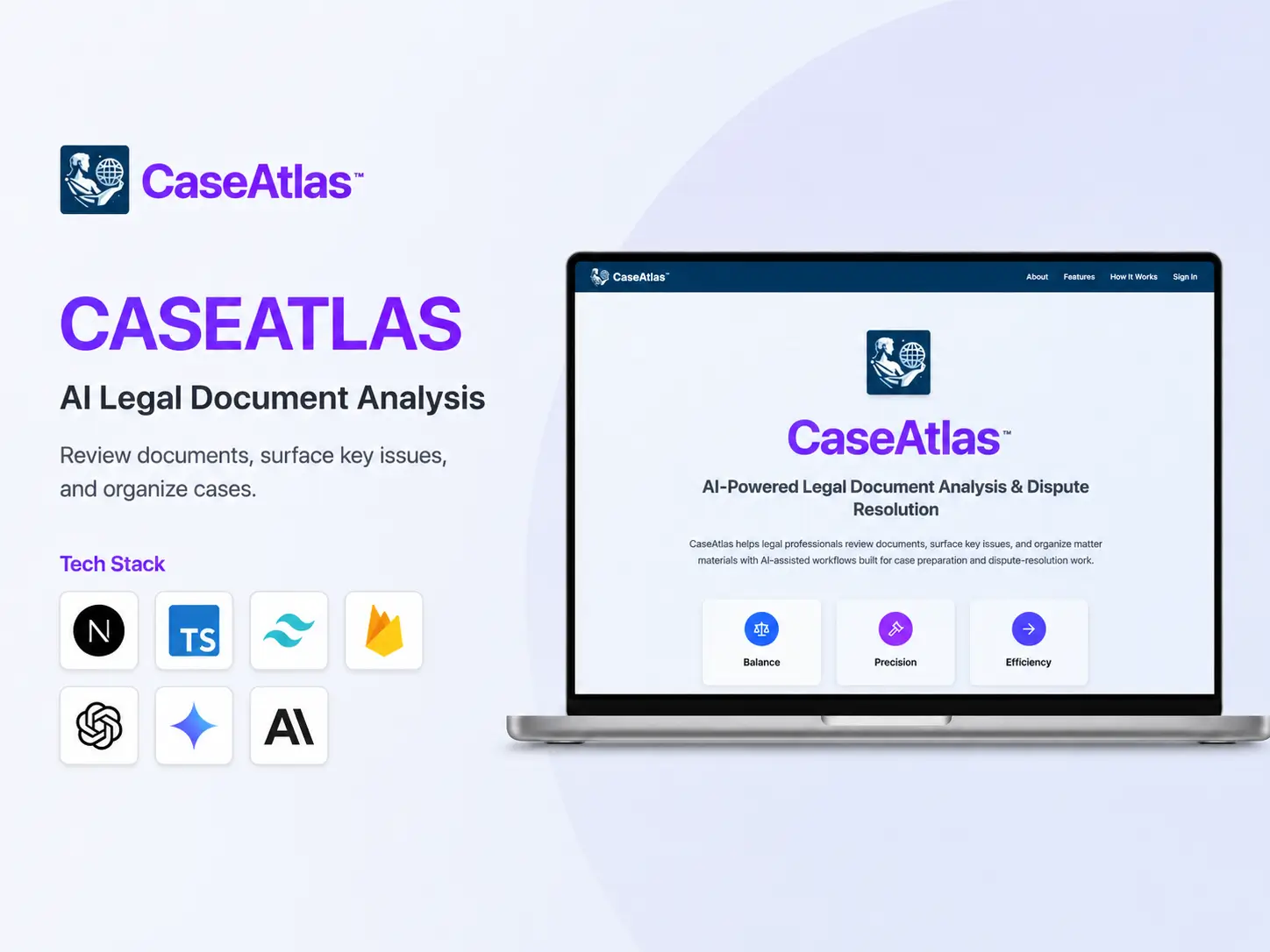
CaseAtlas is an AI-powered legal case intelligence platform designed to help attorneys organize case information, analyze evidence, identify strategic gaps, and turn complex matter data into structured legal insights.
The platform combines a visual case workspace, document ingestion, Retrieval Augmented Generation (RAG), semantic search, AI-assisted case analysis, timelines, valuation workflows, authentication, and subscription billing.
Tech Stack: Next.js, React, TypeScript, Clerk, Firebase, Firebase Admin SDK, Cloud Storage, Unstructured API, Ragie, OpenAI API, Anthropic Claude, Google Gemini, and Stripe.
AI-Powered Legal Case Intelligence with RAG-Based Document Retrieval and Multi-Model AI Integration.
Structured Case Analysis with Evidence Timelines, Strategic Gap Identification, and Credit-Based Usage Controls.
Core Tech: Next.js | React | TypeScript | Firebase | Clerk | Ragie | Unstructured API | OpenAI | Claude | Gemini | Stripe
Button: View Live Project
Problem Statement
1. Complex Legal Documents and Unstructured Case Data
Legal case materials can contain extensive, unstructured information that needs to be organized and retrieved before it can support useful case analysis.
2. Retrieving Relevant Evidence from Large Documents
Analyzing lengthy case files requires a way to locate relevant passages and provide focused context to AI models without relying on entire documents being sent to the model.
3. Connecting AI Analysis with Legal Workflows
Attorneys need more than a standalone AI chatbot. Case information, evidence, timelines, liability, damages, risks, and potential strategic gaps need to be organized within a structured case workspace.
4. Managing AI Usage and Subscription Costs
AI analysis and document-processing services consume variable resources, requiring subscription billing, usage credits, and pre-request checks to manage consumption.
Solution Statement
1. RAG-Based Document Intelligence
Integrated the Unstructured API and Ragie to build a document pipeline covering parsing, text extraction, content normalization, indexing, semantic retrieval, and relevant-context selection for AI analysis.
2. Multi-Model AI Integration
Integrated OpenAI, Anthropic Claude, and Google Gemini through a configurable AI layer, allowing model selection to adapt to application requirements and changing provider capabilities.
3. Structured Case Intelligence and Timelines
Built AI-assisted workflows for case summaries, evidence analysis, strategic gap identification, case-strength analysis, defense-argument identification, valuation support, and chronological case timelines.
4. Authentication, Billing, and Usage Controls
Integrated Clerk authentication, Firebase backend services, Cloud Storage, Stripe subscriptions, and credit-based usage metering for AI and document-processing operations.
Features
- AI-powered legal case analysis.
- Visual case and evidence organization.
- Matter-level case intelligence.
- AI-generated case summaries.
- Strategic gap identification.
- Defense-argument analysis.
- Case valuation support.
- Liability, damages, insurance, and risk analysis.
- Automatic case timeline generation.
- Legal document parsing and text extraction.
- RAG-powered document retrieval.
- Semantic search across case materials.
- Multi-model AI support with OpenAI, Claude, and Gemini.
- PDF and report generation.
- Clerk authentication and account management.
- Firebase backend and Cloud Storage integration.
- Stripe subscription billing.
- Credit-based AI and document-processing usage controls.
Benefits
- Better Case Organization: Brings case information and evidence into a structured legal workspace.
- More Focused Document Analysis: RAG retrieves relevant passages to provide AI models with context from case materials.
- Streamlined Case Intelligence: Supports summaries, evidence analysis, strategic gap identification, and defense-argument workflows.
- Clearer Case Timelines: Organizes dated information chronologically to help review how case events developed.
- Flexible AI Integration: Supports multiple AI providers through a configurable model layer.
- Controlled AI Consumption: Credit-based usage controls connect resource-intensive AI and document-processing operations with billing.
- Integrated Account Management: Clerk and Firebase support authenticated application workflows and account-associated data.
- Connected SaaS Billing: Stripe subscriptions and usage credits support the platform’s billing model.
My Role
As the full-stack developer, I worked across the product experience, authentication, cloud data services, document ingestion, RAG infrastructure, multi-model AI integration, legal case workflows, Stripe billing, credit metering, and production deployment.
My responsibilities included building the Next.js application, integrating Clerk and Firebase, connecting Unstructured and Ragie, developing AI-assisted legal analysis workflows, integrating OpenAI, Claude, and Gemini, and implementing subscription and usage-control functionality.
Core Expertise Demonstrated
AI full-stack development, LegalTech, AI SaaS, Next.js, React, TypeScript, document intelligence, legal case analysis, Retrieval Augmented Generation (RAG), semantic search, vector retrieval, Unstructured API, Ragie, OpenAI API, Anthropic Claude, Google Gemini, multi-model AI integration, Firebase, Firebase Admin SDK, Cloud Storage, Clerk authentication, Stripe integration, subscription billing, credit-based usage metering, software architecture, and SaaS development.