

Software applications need regular updates to remain useful, secure, and competitive. Developers introduce new features, fix existing problems, and improve application performance. However, even a small code change can affect something that previously worked correctly. This is where regression testing becomes important.Regression testing helps development teams confirm that recent updates have not damaged existing functionality. It plays an important role in maintaining application stability, improving user experience, and reducing unexpected problems after software releases.I’m Ahmed Raza, and I believe reliable software development requires more than adding new features. Teams must also protect the functionality users already depend on. In this guide, we’ll explore how regression testing works, why businesses need it, and which practices help achieve better software quality.
What Is Regression Testing?
Regression testing is a software testing process that checks whether existing application features continue working correctly after code changes, updates, bug fixes, or system improvements.For example, imagine an e-commerce website introduces a new payment option. The development team updates the checkout process to support this feature. However, the update might accidentally affect shopping carts, discount calculations, or existing payment methods.Regression testing helps identify these problems before customers experience them.It focuses on protecting previously working functionality while allowing developers to introduce improvements confidently.
Why Is Regression Testing Important for Modern Software?
Software applications rarely remain unchanged. Businesses continuously introduce updates to meet customer expectations, improve security, and maintain competitive advantages.Without proper testing, these changes can introduce unexpected defects into existing features.Regression testing provides a structured way to identify problems before they reach production environments.
1. Prevents Unexpected Software Bugs
A small code modification can create problems in another part of an application. These issues are particularly common when multiple features depend on shared components.Regression testing helps developers identify unexpected changes before releasing updates.
2. Protects User Experience
Customers expect applications to work consistently after every update. A broken login page, payment failure, or missing feature can quickly damage user confidence.Regular testing helps maintain a consistent experience across application versions.
3. Reduces Development Costs
Finding defects during development is generally less expensive than fixing them after deployment.Early detection also reduces emergency maintenance, customer complaints, and unnecessary development work.
4. Supports Faster Software Releases
Development teams often work with tight release schedules. A reliable regression testing strategy helps them verify important features without repeating every testing activity manually.This makes continuous integration and continuous delivery workflows more manageable.
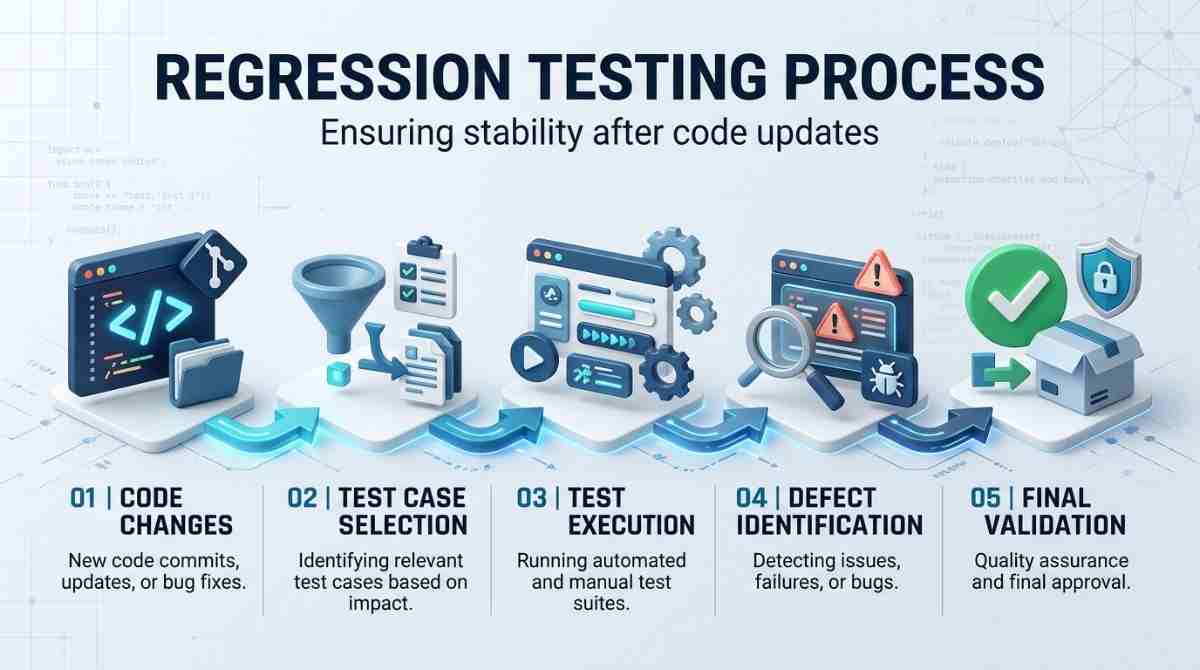
How Does Regression Testing Work?
Regression testing follows a structured process that helps teams evaluate the impact of software changes.The exact workflow depends on application complexity, development methodology, and available testing resources.
Step 1: Identify Recent Code Changes
The testing team first reviews recent updates, bug fixes, and newly introduced features.Understanding what changed helps identify which application areas might be affected.
Step 2: Select Relevant Test Cases
Not every test case needs to run after every modification. Testers select cases based on the affected functionality and potential risks.Critical features usually receive higher testing priority.
Step 3: Execute Regression Tests
Selected test cases are executed manually or through automation tools.The team checks whether existing features behave as expected and whether new changes have introduced unexpected defects.
Step 4: Analyze Results and Report Issues
Testers compare actual results with expected outcomes.Any failures are documented, investigated, and shared with developers for correction.
Step 5: Retest and Validate
After developers resolve reported issues, the testing team repeats relevant tests.This confirms that the corrections work and have not introduced additional problems.
Common Types of Regression Testing
Different applications require different regression testing approaches. Selecting the right method depends on the scope of changes and the level of risk involved.
| Testing Type | Purpose | Best Used When |
|---|---|---|
| Corrective Regression Testing | Reuses existing test cases | Requirements remain unchanged |
| Progressive Regression Testing | Tests updated requirements | New features are introduced |
| Selective Regression Testing | Tests affected application areas | Limited code changes occur |
| Complete Regression Testing | Tests the entire application | Major system changes are implemented |
| Partial Regression Testing | Tests related modules | Changes affect connected components |
Choosing the Right Testing Approach
A smaller application update may only require selective regression testing. However, major architectural changes might justify broader testing coverage.The goal is to balance testing coverage, available resources, and release timelines.
Manual vs Automated Regression Testing
Both manual and automated regression testing contribute to software quality. However, they serve different purposes.Manual testing involves human testers executing test cases and examining application behavior. Automated testing uses scripts and testing frameworks to perform predefined checks.
| Comparison | Manual Testing | Automated Testing |
|---|---|---|
| Execution | Performed by testers | Performed using scripts |
| Speed | Usually slower | Faster for repeated tests |
| Initial Cost | Generally lower | Requires setup and maintenance |
| Reusability | Test cases are repeated manually | Scripts can be reused |
| Human Judgment | Strong for exploratory testing | Limited to programmed checks |
| Best For | Small changes and usability checks | Repeated and large test suites |
When Should Businesses Choose Automation?
Automation is particularly useful when teams frequently release updates and need to execute the same test cases repeatedly.However, automation does not eliminate the need for experienced testers. Human judgment remains valuable when evaluating usability, unexpected behavior, and complex business requirements.
Best Practices for Effective Regression Testing
A successful testing strategy requires planning, clear communication, and regular improvements.Teams should focus on meaningful test coverage rather than simply increasing the number of test cases.Before implementing a regression testing process, development and QA professionals should understand application priorities.
They should identify important business workflows and determine which features carry the greatest operational risk.
A well-organized test suite makes it easier to maintain consistency across different releases.
The following practices can help improve testing efficiency and reliability.
-
Prioritize Critical Features: Focus on essential workflows such as user authentication, payment processing, account management, and data handling.
-
Maintain Test Cases: Review and update test cases whenever application functionality or business requirements change.
-
Use Automation Strategically: Automate repetitive tests that need frequent execution, while retaining manual testing for complex scenarios.
-
Monitor Testing Results: Track failed tests, recurring defects, test coverage, and execution time to identify opportunities for improvement.
Regression Testing Tools Worth Considering
Choosing appropriate tools can make regression testing easier to manage, especially when applications contain multiple modules and frequent updates.
Different tools support different testing requirements.
Selenium
Selenium is widely used for automating browser-based application testing. It supports multiple programming languages and browsers.
Cypress
Cypress provides tools for testing modern web applications. It is particularly useful for front-end testing workflows.
Playwright
Playwright supports cross-browser automation and provides features for reliable end-to-end testing.
JUnit
JUnit helps Java development teams organize and execute automated tests.The best choice depends on the application’s technology stack, testing requirements, and team expertise.
Why Choose Us for Regression Testing?
At Ahmed Raza, we believe software quality should remain a priority throughout the development lifecycle. Businesses need reliable testing practices to protect their applications and maintain customer confidence.Our approach focuses on understanding application requirements, identifying potential risks, and supporting consistent software quality.
A Practical Approach to Software Quality
We believe effective testing should address real application requirements rather than rely on generic checklists.
Our approach emphasizes:
-
Requirement-Based Testing: Understanding application functionality before selecting relevant regression test cases.
-
Quality-Focused Strategies: Prioritizing important workflows and identifying areas that may be affected by software changes.
-
Automation Where Appropriate: Using suitable testing tools to support repetitive testing activities.
-
Clear Communication: Providing understandable testing findings and actionable recommendations.
For businesses in Denver, Colorado, choosing a testing partner should involve evaluating technical knowledge, communication, testing methodology, and the ability to understand business requirements.Our goal is to help businesses make informed decisions about software quality and build more dependable applications.

The Future of Regression Testing
Software development continues to evolve through artificial intelligence, cloud computing, and continuous delivery practices.These developments are changing how testing teams identify defects and manage application quality.AI-assisted testing can help identify patterns, suggest test cases, and support test maintenance. Cloud-based environments also make it easier to test applications across different devices and configurations.However, technology alone cannot guarantee reliable software. Clear requirements, thoughtful test planning, and experienced professionals remain essential.Regression testing will continue to play an important role in helping businesses release software confidently.
Frequently Asked Questions About Regression Testing
1. What is the main purpose of regression testing?
The main purpose is to verify that existing software functionality continues working correctly after code changes, bug fixes, updates, or new feature implementations.
2. When should regression testing be performed?
It should be performed after significant code changes, bug fixes, feature updates, integrations, and before important software releases.
3. Is regression testing manual or automated?
Regression testing can be performed manually or automatically. Many development teams combine both approaches to achieve better coverage and efficiency.
4. Which tools are commonly used for regression testing?
Popular tools include Selenium, Cypress, Playwright, and JUnit. The right tool depends on application technology and testing requirements.
5. How is regression testing different from retesting?
Retesting verifies whether a previously reported defect has been fixed. Regression testing checks whether recent changes have negatively affected existing application functionality.
6. Why do businesses in Denver need regression testing?
Businesses in Denver that develop websites, mobile applications, or enterprise software can use regression testing to identify defects, protect existing features, and maintain consistent application performance.
Final Thoughts
Regression testing is an essential part of maintaining dependable software. Every update introduces the possibility of unexpected changes, making it important to verify existing functionality before releasing new versions.By selecting appropriate testing methods, maintaining useful test cases, and combining manual and automated approaches, development teams can improve software quality and reduce release risks.As Ahmed Raza, I believe successful software development is not just about introducing new features. It is also about ensuring that everything users already trust continues working as expected.