

Austin’s reputation as Silicon Hills isn’t marketing language anymore. With over 5,500 active tech companies, Tesla’s robotics expansion, a planned multi-billion dollar Terafab AI chip facility and large-scale Texas data centers coming online, the city has quietly become one of the most aggressive AI adoption markets in the United States. For local founders and operators, that creates both an opportunity and a challenge: how do you actually move from “we should be using AI” to a production system that ships measurable revenue?
This guide is written for Austin business owners, operations leaders and engineering managers who are seriously evaluating AI development and integration in 2026. Drawing from ten years of building production systems for companies like Amazon, Warner Bros and Moment House, I’ll walk you through what these services genuinely involve, how custom AI solutions differ from off-the-shelf tools, realistic costs and the exact questions to ask before signing with any AI development company in Austin or beyond.
Why Austin Businesses Are Doubling Down on AI Development and Integration
Silicon Hills Is Now a Serious AI Hub
Austin now supports more than 200,000 tech jobs — roughly 16% of total employment, almost double the national rate. The presence of Tesla, Apple, Oracle, Dell, IBM, CrowdStrike and homegrown unicorns like Anaconda and Iodine Software has pulled in capital, talent and infrastructure. Add the planned Terafab facility, the Austin AI Alliance’s annual State of AI report and the broader Texas data-center buildout and you have a regional environment where AI services in Texas are no longer experimental they’re table stakes.
The pressure on mid-market Austin companies is real. If your competitor in the same Zilker office park is using LLMs to triage support tickets, automating contract review with a fine-tuned model, or running computer vision quality checks on a production line, staying with manual workflows is a structural disadvantage that compounds month over month.
It’s Not About Hype — It’s About Margin
The teams I work with rarely start with “we want AI.” They usually start with something more honest: “our support team is drowning,” “we can’t keep up with personalization,” or “we spend 30 hours a week on document review.” AI development and integration becomes the answer because it’s the cheapest, fastest way to reclaim those hours and redeploy people toward higher-value work.
What AI Development and Integration Actually Mean in 2026
Before going deeper, let’s clear up a confusion I see constantly with first-time buyers: AI development and AI integration are related but different services and the right project usually mixes both.
AI Development: Building From Scratch
AI development is the process of designing intelligent systems where commodity tools won’t do the job. That includes choosing or designing models, training them on your proprietary data, deploying them through APIs, and maintaining them with MLOps practices. It involves machine learning, neural networks, deep learning, NLP computer vision and increasingly large language models (LLMs). Custom AI solutions — where the model is genuinely tailored to your business, your data and your edge cases fall squarely into this category.
AI Integration: Plugging Intelligence Into What You Already Have
AI integration is the work of connecting existing AI capabilities into your products, workflows and tech stack. Think wiring OpenAI’s API into your CRM, embedding a vision model from AWS or GCP into your inventory app, or connecting a vector database to your support portal so agents get instant context on every conversation. Integration is usually faster and cheaper than full development, but it requires the same architecture discipline — bad integration creates technical debt that’s painful to undo later.
Most Austin businesses I consult with need a mix: integration where commodity AI is genuinely “good enough,” and custom development where the data, the workflow, or the compliance requirement is unique.
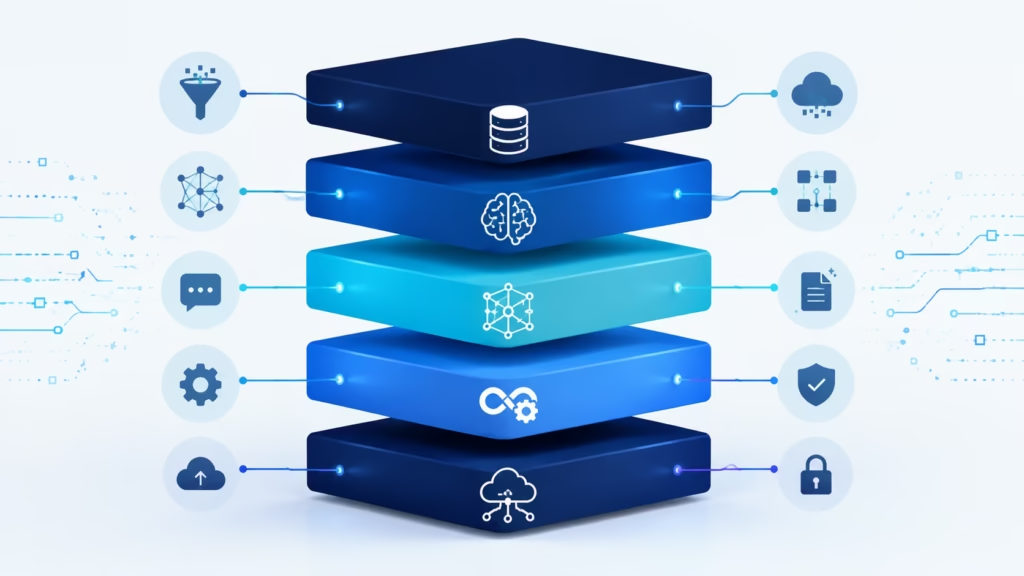
The Core Building Blocks of a Modern AI Stack
A well-engineered AI system has more parts than just “the model.” Here’s what we typically design, deploy, and maintain:
- Machine learning forms the foundation — algorithms that learn from historical data to predict, classify, or cluster.
- Deep learning and neural networks power the heavier lifting, from image and audio understanding to advanced reasoning tasks.
- Natural Language Processing (NLP) handles anything text-based: chatbots, sentiment analysis, search, summarization, and structured document parsing.
- Computer vision lets systems see — reading invoices, inspecting products on a line, verifying IDs, counting foot traffic.
- Large Language Models (LLMs) sit on top of all of the above and have become the default interface for everything from internal copilots to customer-facing assistants.
- MLOps is the unglamorous but critical practice of versioning models, monitoring drift, automating retraining, and rolling back when production breaks.
- APIs glue everything together so the AI doesn’t sit isolated in a notebook — it actually powers your SaaS app, your mobile experience, and your back office in real time.
When this stack is designed correctly, it becomes the engine behind genuine digital transformation, not just a flashy feature on a sales deck. Cloud providers like AWS Machine Learning and Google Cloud AI give Austin teams enterprise-grade infrastructure to build on without managing GPUs themselves.
High-Impact AI Use Cases for Austin and Texas Businesses
Customer Support Automation
Support tickets are the gateway use case for most SaaS companies. A well-tuned LLM, connected to your knowledge base and CRM, can resolve 30–60% of repetitive tickets, draft replies for human agents on the rest, and intelligently triage what needs escalation. For Austin SaaS companies scaling past 10,000 customers, this is often the highest-ROI integration available in the first 90 days.
Recruitment, HR and Hiring
I’ve shipped this firsthand. Working on the AiRecruiter platform case study, I built automation across resume screening, candidate scoring, and interview follow-ups using Node.js, AWS Lambda, the Serverless framework, and DynamoDB. The result was a measurable drop in time-to-hire and a noticeable lift in candidate quality.
Generative AI Products
The Supermeme case study shows how generative AI can sit at the heart of a consumer product — turning plain text into shareable memes — rather than being relegated to the back office. For founders building consumer or creator-focused tools, generative AI is no longer a feature; it’s often the entire product.
Document and Finance Operations
NLP combined with OCR can read invoices, contracts, leases, and statements faster and more accurately than humans on routine work. Austin’s legal, real estate, and energy sectors get outsized value here because document volume is high and accuracy expectations are non-negotiable.
Predictive Analytics
Forecasting demand, churn, ad performance, supply-chain risk — classical machine learning still wins on tabular business data, and most companies haven’t tapped even half of what their existing data already supports.
Computer Vision for Physical Operations
Manufacturing, logistics, and physical retail across Texas are deploying vision models for quality control, shelf monitoring, and worker safety — exactly the “physical AI” trend that Austin’s hardware ecosystem is leaning into hard in 2026.
How to Choose the Right AI Development Company in Austin
Choosing a partner is harder than choosing a model. Most agencies pitch the same buzzwords. The table below is the comparison framework I’d genuinely use if I were a buyer on the other side of the table.
AI Partner Options for Austin Businesses
| Criteria | Big-Brand Consultancy | Local Austin AI Agency | Independent Senior Engineer (e.g., Ahmad Raza) | Offshore Generalist |
| Typical Project Cost | $250K–$1M+ | $80K–$300K | $25K–$120K | $10K–$60K |
| Time to First Production Release | 6–9 months | 3–5 months | 4–10 weeks | Variable, often slips |
| Engineering Depth | High but layered | Medium–High | High, hands-on | Mixed |
| Cloud Certifications (AWS / GCP) | Yes | Often | Yes | Sometimes unverified |
| MLOps Maturity | Strong | Variable | Strong, opinionated | Usually weak |
| Direct Access to Senior Talent | Limited — junior delivery | Medium | Direct — same person who scopes builds it | Limited |
| Best For | Fortune 500, regulated industries | Funded startups, mid-market | Startups, SMBs, fast iteration | Throwaway prototypes |
What to Actually Evaluate
A few signals worth checking before you sign anything:
- Engineering depth. Can the team ship production systems, or just build demos that fall over under real load?
- Cloud experience. AWS-, GCP-, or Azure-certified engineers reduce risk and shorten infrastructure debates.
- MLOps maturity. Anyone can prototype. Very few teams keep a model healthy in production six months in.
- Integration experience. Does the team know your existing stack — Node.js, NestJS, React, Next.js, PostgreSQL, MongoDB?
- Domain understanding. An AI development company in Austin that has already shipped for your industry is worth a real premium.
- Honesty about limits. Run, don’t walk, from anyone who promises “AI will solve everything.”
My 6-Step AI Development and Integration Process
After a decade of building for companies in 16+ countries, I’ve settled on a process that consistently keeps projects on budget and on time:
- Discovery and ROI scoping. Before we touch code, we map the business problem, the data you actually have, and a defensible ROI hypothesis. If the math doesn’t work, I’ll tell you.
- Architecture and stack design. We choose the right cloud (AWS or GCP), the right model approach (fine-tune vs. RAG vs. classical ML), and the right integration surface — REST APIs, webhooks, SDKs, or embedded SaaS modules.
- Data preparation and pipelines. Clean, well-labelled data is 70% of the work. We build ingestion, labelling, and validation pipelines that survive past launch.
- Model development or integration. Whether we’re fine-tuning an LLM or wiring up a third-party API, this is where the working prototype takes shape.
- Production hardening and MLOps. Versioning, monitoring, drift detection, automated retraining, and rollback. This step is what separates a “demo” from a real product.
- Handover, documentation, and ongoing support. You get clean code, clear documentation, and a partner who answers when things break at 11 PM on a Tuesday.
Common Mistakes Austin Businesses Make With AI Projects
A handful of patterns show up over and over, and they’re worth flagging:
- Starting with the model instead of the problem. “We want to use GPT-5” is not a strategy. “We want to cut average ticket resolution from 18 minutes to 4 minutes” is.
- Underestimating data work. If your data lives in five disconnected systems with inconsistent schemas, that’s where 60% of the budget will go — and it should.
- Ignoring QA strategies and evaluation. AI systems need test harnesses just like any other software. Skip this and you’ll ship hallucinations to your customers.
- Locking into one vendor. Build with portability in mind. Model providers change pricing, deprecate APIs, and occasionally just disappear.
- Treating launch as the finish line. A model that ships at 92% accuracy can decay to 78% in six months if no one is watching drift.
Realistic Costs and ROI for AI Services in Texas
Austin pricing sits between Silicon Valley and the rest of the country. For a useful planning baseline:
- Lightweight AI integration (LLM + existing SaaS, no custom training): $15K–$45K.
- Mid-complexity custom AI solution (fine-tuned model, custom data pipeline, dashboard): $50K–$150K.
- Full enterprise AI build (multi-model system, MLOps, compliance, custom UI): $150K–$500K+.
The ROI math, in my experience, tends to be more favorable than founders expect. A well-scoped support-automation project usually pays back inside 6–9 months. A document-processing system for a legal or finance ops team often pays back inside 3–6 months. The biggest variable isn’t the model — it’s how well-defined the workflow was before you started.

About the Author
Ahmad Raza is a Senior Full Stack Engineer with 10+ years of experience designing, building, and shipping production-grade web, mobile, and AI systems. He has delivered work for Fortune 100 companies including Amazon, Warner Bros, and Moment House, completed 50+ projects for clients across 16 countries, and maintains a 100% on-time delivery record with 520+ five-star reviews on Upwork.
Credentials:
- 10+ years building scalable systems with Node.js, NestJS, React, Next.js, PostgreSQL, and MongoDB
- Hands-on AWS and Google Cloud Platform experience (Lambda, SQS, DynamoDB, GCP AI services)
- Verified partner distinctions from Google, Facebook, and Salesforce
- Documented AI case studies including AiRecruiter and Supermeme
- Featured on the projects portfolio with client logos and testimonials from CTOs at MomentHouse, Makeen Technologies, AiRecruiter, and HOAH
Frequently Asked Questions
What is AI development and integration, in simple terms?
AI development is building intelligent systems — usually involving machine learning, neural networks, or LLMs — that are tailored to your specific business problem. AI integration is the work of connecting those systems (or existing third-party AI APIs) into your current apps, websites, and workflows so the intelligence actually reaches your users and your team.
How long does an AI development and integration project usually take?
A focused integration project can be production-ready in 4 to 10 weeks. A custom AI solution with fine-tuning, data pipelines, and MLOps typically takes 3 to 6 months. Enterprise-grade builds with compliance and multi-model architectures can run 6 to 12 months. The biggest accelerator is having clean data and a tightly scoped use case before development starts.
Do I need an Austin-based AI development company specifically?
Not strictly. Geography matters less than engineering quality, cloud certifications, and proven case studies. That said, working with someone familiar with the Silicon Hills ecosystem — Austin’s hiring market, local compliance norms, and the Texas regulatory landscape — can shorten ramp time, especially for healthcare, fintech, and energy use cases.
What’s the difference between custom AI solutions and off-the-shelf AI tools?
Off-the-shelf tools (ChatGPT plugins, no-code AI builders) are fast and cheap but generic. Custom AI solutions are built around your proprietary data, your workflows, and your competitive moat. The right answer depends on whether AI is core to your product (build custom) or a productivity layer behind the scenes (often integrate off-the-shelf).
How do you measure ROI on AI development and integration?
Good AI projects are tied to a single, defensible metric before code is written — ticket resolution time, cost per lead, document processing throughput, conversion rate, fraud-detection accuracy. We then instrument that metric in production and measure it against a pre-AI baseline. If the math doesn’t work in the first 90 days, the project gets paused, not extended.
Ready to Build Your AI Solution? Let’s Talk.
If you’re an Austin founder, operations leader, or engineering manager who’s ready to move from AI conversation to AI deployment, I’d love to scope the right path for your business. Whether you need a tightly scoped integration or a full custom AI solution, you’ll work directly with me — not a sales team.
👉 Book a free consultation call with Ahmad Raza or explore my full case study portfolio to see how I’ve helped startups and Fortune 100 companies ship AI that actually moves the numbers.