

If you’re a Texas founder trying to ship a real AI product in 2026, not a flashy demo, but something that handles real users, real data and real compliance, your hardest decision isn’t which model to use. It’s who builds it with you. The best custom AI application developers for data integration and governance aren’t picked from a list of buzzwords; they’re picked by how they handle your data, your compliance stack and your edge cases when the project gets uncomfortable.
This guide is built from ten years of shipping production systems for Amazon, Warner Bros, Moment House and 50+ clients across 16 countries. I’ll walk you through the exact step-by-step process I use for custom AI app development in Texas, the cloud platforms worth evaluating (Azure OpenAI, AWS Bedrock, GCP Vertex), the Texas-specific compliance traps most founders miss and the client outcome metrics you should expect from any serious AI product development partner.
Why “Custom” Beats Off-the-Shelf for Texas Businesses in 2026
Austin’s startup landscape has matured in a very specific direction. With more than 5,500 active tech companies, Tesla’s robotics build-out, planned AI chip facilities and a deepening enterprise AI buyer base, Texas startups are no longer competing on novelty. They’re competing on margin, retention and defensibility and that’s exactly where off-the-shelf AI tools start to break down.
Generic AI tools work fine when the problem is generic. The moment your product needs proprietary data, industry-specific accuracy, your own brand voice, or a workflow that doesn’t exist anywhere else, custom is the only honest answer. The best AI developers in Texas today aren’t selling you “AI” — they’re selling you ownership of an AI product that’s tuned to your business and protected by a governance framework that survives an audit.
There’s also a quieter reason custom is winning. SaaS vendors change pricing, deprecate models and occasionally just disappear. A custom AI application built on infrastructure you control with code you own is the only version of this technology that won’t be held hostage to someone else’s roadmap.
What the Best Custom AI Application Developers Actually Do Differently
They Treat Data Integration as the Real Problem
In every serious AI project I’ve shipped, 60% of the effort goes into the data pipeline, not the model. The best custom AI application developers for data integration and governance start by mapping where your data actually lives your CRM, your PostgreSQL or MongoDB databases, your warehouse, your file storage, your third-party APIs and they design ingestion, cleaning, validation and labelling pipelines that survive past launch. If a developer wants to start with prompts and skip the data layer, that’s the moment to walk away.
They Bake Governance Into the Architecture
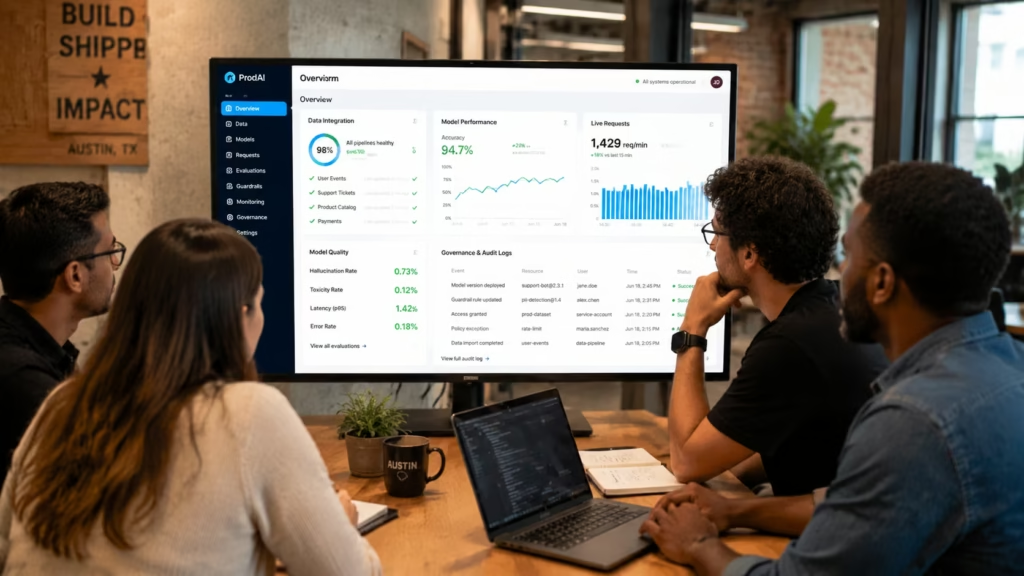
Governance is not a PDF you write at the end. A real governance framework includes access controls, audit logs, model versioning, drift monitoring, PII handling rules, retention policies and a clear chain of accountability for every model decision. With Texas now actively enforcing TDPSA and the Texas Attorney General investigating AI platforms for compliance failures, building governance in from day one is the cheapest insurance you can buy.
They Stay Honest About the Tech Stack
A serious custom AI app development partner will tell you exactly what they’re using frameworks, cloud services, models, vector stores, observability tools and explain why before you sign anything. If the proposal says “we use AI” without naming specifics, the proposal is hiding something.
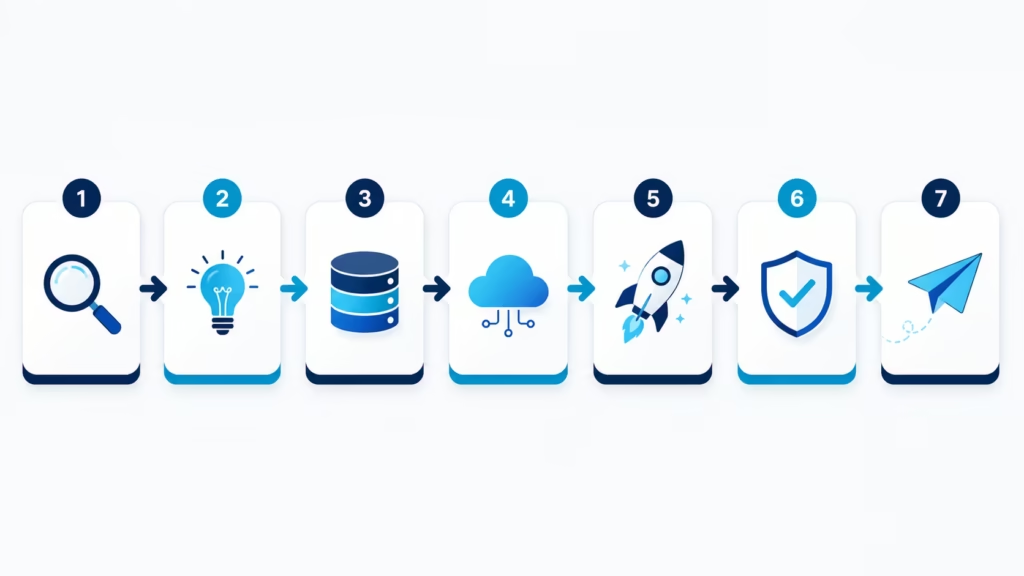
The Step-by-Step Process for Custom AI App Development
After a decade of shipping production AI and full-stack systems, I’ve narrowed the process down to seven steps that consistently keep projects on budget and on schedule. This is the same process I use whether the client is a Texas SaaS startup or a Fortune 100 partner.
Step 1: Discovery and Problem Definition
Before any code is written, we spend 1–2 weeks defining the business problem in measurable terms. Not “we want to use AI” but “we want to cut average ticket resolution from 18 minutes to 4 minutes,” or “we want to lift recruiter shortlist accuracy by 30%.” If the metric isn’t clear, the project shouldn’t start.
Step 2: Proof of Concept (POC)
The POC is a small, throwaway prototype that validates whether AI can actually solve the problem with the data you have. POCs should be cheap (1–3 weeks), narrowly scoped and judged against a pass/fail criterion you set in Step 1. About 1 in 5 POCs I run quietly fails and that’s a feature, not a bug. Better to learn it in week 3 than month 6.
Step 3: Data Pipeline and Governance Framework
Once the POC passes, we design the production data pipeline: ingestion from your sources, schema validation, cleaning, labelling, PII detection and masking, audit logging and storage. This is also where the governance framework gets locked in who can access what, how model decisions are logged, how data is retained and how the entire system maps to TDPSA and (where relevant) HIPAA.
Step 4: Cloud AI Platform Selection
Choosing between Azure OpenAI, AWS Bedrock and GCP Vertex is one of the most consequential decisions in custom AI app development. The right answer depends on where your data already lives, what your compliance posture requires and how much fine-tuning vs. straight inference you need. I’ll show the full comparison table in the next section.
Step 5: MVP Build With Agile Sprints
The Minimum Viable Product (MVP) is the first release with real users on real data. We work in 1- or 2-week agile sprints with weekly demos, written changelogs and a shared backlog. Most Texas startup MVPs ship between weeks 8 and 14 from kickoff. The discipline of agile here matters more than the methodology — what counts is that you see working software every Friday.
Step 6: Compliance, QA and Pre-Launch Hardening
Before launch, we run structured QA strategies, security testing, evaluation harnesses for AI outputs (to catch hallucinations and drift), load testing, and a final compliance review against TDPSA and any sector-specific requirements (HIPAA, SOC 2, PCI). Skip this step and you’ll learn the same lessons your customers learn on your customers.
Step 7: Launch and Iterate
Launch isn’t the finish line; it’s the start of the MLOps phase. Models drift, data changes, user behavior shifts. A production AI app needs monitoring dashboards, automated retraining triggers, rollback procedures and a partner who picks up the phone when something breaks at 11 PM on a Tuesday.
Cloud AI Platform Comparison: Azure OpenAI vs AWS Bedrock vs GCP Vertex
Most Texas custom AI projects end up on one of three cloud AI platforms. Here’s an honest, builder’s-perspective comparison.
| Criteria | Azure OpenAI | AWS Bedrock | GCP Vertex AI |
| Best For | Enterprises already on Microsoft 365 / Azure | AWS-native stacks, multi-model flexibility | Data-heavy ML, Google Workspace shops |
| Headline Models | GPT-4o, GPT-4.1, o-series, embeddings | Claude (Anthropic), Llama, Mistral, Titan, Cohere | Gemini, PaLM, third-party via Model Garden |
| Fine-Tuning Support | Strong for OpenAI models | Strong, varies by provider | Strong, native Vertex tooling |
| Compliance Coverage | HIPAA, SOC 2, ISO 27001, FedRAMP High | HIPAA, SOC 2, ISO 27001, FedRAMP | HIPAA, SOC 2, ISO 27001, FedRAMP |
| Texas Data Residency | Texas region available | us-east, us-west (Texas via VPC peering) | us-central1 (Iowa), regional options |
| Pricing Predictability | Token-based, predictable | Pay-per-token by provider, variable | Token-based, competitive |
| Best Integration With | Microsoft 365, Dynamics, Power Platform | RDS, DynamoDB, Lambda, S3, SageMaker | BigQuery, Looker, Firebase |
| Typical Learning Curve | Moderate | Steeper (multi-model) | Moderate–steep |
For a deeper take on how these platforms fit into a broader integration strategy, my previous guide on AI development and integration for Austin businesses covers the architecture-level decisions in more detail. You can also evaluate each platform directly through the official docs: Azure OpenAI Service, AWS Bedrock and Google Cloud Vertex AI.
The Tech Stack I Use to Build Production-Grade Custom AI Apps
Here’s exactly what I build with:
- Backend: Node.js, NestJS, Express.js, battle-tested for scalable APIs.
- Frontend: React, Next.js, TypeScript for fast, SEO-friendly UIs that integrate cleanly with AI endpoints.
- Databases: PostgreSQL and MongoDB for transactional data; Redis for caching; pgvector or Pinecone for vector storage.
- Cloud & AI services: AWS (Lambda, SQS, DynamoDB, Bedrock), Google Cloud (Vertex, BigQuery) and Azure OpenAI when client infrastructure requires it.
- DevOps: Docker, GitLab CI/CD, NGINX, Cloudflare, DigitalOcean for cost-effective deployments.
- Observability: Structured logging, metrics dashboards, alerting and model-output evaluation harnesses.
You can see this stack in action across the full project portfolio every case study lists the exact tech used and the business outcome it produced.
Texas Compliance Requirements Most Founders Miss
This is the section most “AI agencies” skip. They shouldn’t. Here are the rules that genuinely affect custom AI apps shipped to Texas users in 2026.
Texas Data Privacy and Security Act (TDPSA)
The TDPSA took effect July 1, 2024 and is now actively enforced by the Texas Attorney General. Key points for AI builders:
- Penalties: Up to $7,500 per violation, with civil enforcement by the Texas AG.
- Cure period: Businesses have a 30-day window to remediate alleged violations after notice.
- Consumer rights: Texans can request access, correction, deletion, portability, opt-out of sale, opt-out of targeted advertising and opt-out of profiling. You have 45 days to respond.
- Sensitive data opt-in: Biometric data, precise geolocation and health-related data require explicit opt-in consent.
- Universal opt-out signals: Since January 1, 2025, businesses must honor Global Privacy Control (GPC) signals.
- Small business exemption: Businesses meeting the U.S. Small Business Administration’s small-business definition are exempt — but if you process sensitive data, that exemption shrinks.
In December 2024, the Texas AG initiated investigations into Character.AI, Reddit, Instagram and Discord over privacy and safety practices, including under the TDPSA and the SCOPE Act. The signal is clear: AI platforms processing Texas user data are now an enforcement priority.
HIPAA, SOC 2 and Sector-Specific Rules
If your AI app touches healthcare data, HIPAA applies the moment a Texas user is involved. If you sell into financial services, SOC 2 and (often) PCI controls will be on your security questionnaire. Custom AI applications should be designed assuming these reviews will happen.
NIST AI Risk Management Framework
For broader governance, the NIST AI Risk Management Framework is the de facto reference standard most Texas enterprise buyers will expect you to align with especially for AI features that touch hiring, lending, healthcare, or other high-stakes decisions.
Real Client Outcome Metrics from My Portfolio
The best way to evaluate any custom AI app developer is to look at delivered outcomes. Here’s a snapshot from my own portfolio:
- AiRecruiter (case study): Built advanced recruitment automation on Node.js, AWS Lambda, Serverless framework and DynamoDB. The platform streamlined screening and decision-making for HR professionals delivered on a fixed scope, on time.
- Supermeme (case study): Shipped the core text-to-meme generation product for a generative AI consumer tool that’s been featured in product hunt and creator communities.
- OCM Solution (case study): Delivered a SaaS platform for enterprise organizational change management proving the same engineering discipline scales from AI to traditional SaaS.
- Overall track record: 50+ projects across 16+ countries, 520+ five-star reviews on Upwork, 100% on-time delivery, partner distinctions from Google, Facebook and Salesforce.
About the Author
Ahmad Raza is a Senior Full Stack Engineer specializing in custom AI application development, data integration, and governance for startups and enterprise teams. With 10+ years of production experience, he has shipped systems for Amazon, Warner Bros and Moment House, completed 50+ projects across 16 countries and maintains 520+ five-star client reviews.
- Hands-on experience with AWS (Lambda, Bedrock, SQS, DynamoDB), Google Cloud (Vertex, BigQuery) and Azure OpenAI.
- Production AI case studies including AiRecruiter, Supermeme and ROQ BAAS.
- Partner distinctions from Google, Facebook and Salesforce.
- Documented client outcomes, full tech stack transparency, and a complete project portfolio with named client testimonials from CTOs at MomentHouse, Makeen Technologies, AiRecruiter and HOAH.
- Available for direct engagement you work with the engineer who scopes the project, not a sales team.
Frequently Asked Questions (FAQs)
Choosing the Right AI Development Partner
What makes someone one of the best custom AI application developers for data integration and governance?
The best custom AI application developers don’t lead with models—they lead with your data, workflows, and compliance requirements. Look for documented case studies, transparent technology stacks (frameworks, cloud platforms, vector databases, and observability tools), production MLOps experience, and a governance framework that includes access controls, audit logging, drift monitoring, and retention policies.
Anyone who cannot demonstrate these capabilities from the start is unlikely to be prepared for production-grade AI deployments.
Do I need an AI developer based in Texas specifically?
Not necessarily. Engineering quality, cloud certifications, and proven case studies matter more than location. However, working with a team that understands the Austin startup ecosystem, Texas compliance requirements, and local industry regulations can accelerate project delivery—especially in healthcare, fintech, and energy sectors.
Today, many successful projects are delivered through remote engagements with experienced Texas-aware AI engineers.
AI Development Timelines
How long does custom AI app development typically take in Texas?
A focused proof of concept (POC) generally takes between 1–3 weeks. A minimum viable product (MVP) with real users and foundational governance controls often requires 8–14 weeks. Enterprise-grade AI applications featuring advanced data pipelines, multi-model architectures, and comprehensive compliance frameworks typically take between 4–9 months.
The single biggest factor affecting delivery speed is the quality and accessibility of your existing data.
Platform & Infrastructure Decisions
Should I build on Azure OpenAI, AWS Bedrock or GCP Vertex AI?
The best platform depends on where your data already resides and the compliance requirements you must meet.
-
Azure OpenAI is often the strongest choice for organizations already using Microsoft 365, Dynamics, or Azure services.
-
AWS Bedrock offers excellent multi-model flexibility and integrates naturally with AWS-native services such as RDS, DynamoDB, and Lambda.
-
Google Vertex AI is particularly effective for teams heavily invested in BigQuery, Firebase, or Google Workspace.
All three platforms support enterprise compliance standards such as HIPAA, SOC 2, and FedRAMP. In most cases, your existing infrastructure and model requirements should drive the decision.
Texas AI Compliance & Data Privacy
How does Texas data privacy law actually affect my AI app?
If your organization processes personal data belonging to Texas residents and exceeds applicable small-business thresholds, the Texas Data Privacy and Security Act (TDPSA) may apply.
Organizations must typically:
-
Publish a compliant privacy notice
-
Honor consumer rights requests within 45 days
-
Recognize universal opt-out signals (GPC)
-
Obtain consent for sensitive data such as biometrics and geolocation information
-
Implement security safeguards appropriate to the data being processed
Penalties can reach up to $7,500 per violation, and the Texas Attorney General has actively enforced privacy requirements against AI-related platforms since 2024.
For that reason, governance, compliance, and security controls should be incorporated from the beginning of development rather than added later at a significantly higher cost.
Ready to Build Your Custom AI Application? Let’s Talk.
If you’re a Texas founder or operations leader who’s done with demos and ready to ship a real custom AI product, I’d love to scope the right path for your business. You’ll work directly with me same engineer from discovery to deployment — with full tech stack transparency, documented client outcomes and a governance-first approach that protects you against TDPSA enforcement from day one.
👉 Book a free consultation call with Ahmad Raza or browse the complete case study portfolio to see exactly how I’ve helped startups and Fortune 100 teams ship custom AI applications that move the numbers.